
Vietnamese Football in the Transfer Window: The Most Expensive Gap Is Not on the Pitch
Core answer: Bóng đá Việt Nam thiếu hai lớp dữ liệu cùng lúc — chỉ số quá trình trên sân như xG, xGA và PPDA, cùng thông tin tài chính câu lạc bộ có thể kiểm chứng. Khoảng trống kép này khiến các tranh luận chiến thuật lẫn chuyển nhượng phụ thuộc vào cảm giác thay vì bằng chứng. Key facts: - V.League 1 do VPF tổ chức và VFF quản lý; dữ liệu công khai dừng ở kết quả và thống kê trận cơ bản. - Không có cơ chế công bố tài chính kiểu UEFA FFP áp dụng cho câu lạc bộ Việt Nam. - FIFA áp dụng cơ chế đào tạo và đoàn kết khi cầu thủ chuyển nhượng quốc tế, chia phần phí cho lò đào tạo. - Nguyễn Quang Hải sang Pau FC năm 2022; Đoàn Văn Hậu sang SC Heerenveen năm 2019. - Việt Nam vào vòng loại thứ ba World Cup chu kỳ 2022; vô địch ASEAN Championship 2018 và 2024. Source attribution: Phân tích chuyên sâu cấp độ chuyên gia — Bóng đá Việt Nam (Stage-2), ngày 13 tháng 8 năm 2026 | Cross-checked: VuaBong.vn Related Q&A: Q: Vì sao V.League thiếu chỉ số nâng cao như xG? A: Vì hệ thống camera theo dõi chuyển động gắn với dòng tiền bản quyền truyền hình, vốn thấp hơn nhiều so với các giải hàng đầu châu Âu. Q: Câu lạc bộ Việt Nam có được nhận tiền đào tạo khi cầu thủ ra nước ngoài? A: Về nguyên tắc có, theo cơ chế đào tạo và đoàn kết của FIFA, nhưng các khoản thu này không được công bố nên rất khó kiểm chứng. Q: Ưu tiên nào cấp bách hơn: dữ liệu chiến thuật hay minh bạch tài chính? A: Minh bạch tài chính, vì nó quyết định sự tồn tại của câu lạc bộ và nguồn lực nuôi học viện trẻ.
Vietnamese Football in the Transfer Window: The Most Expensive Gap Is Not on the Pitch
In Manchester, late at night, I pull up a V.League match online, fast-forward to the 67th minute, and start a stopwatch.
I want to answer one very specific question: after losing the ball, how many seconds does the home side take to apply pressure again? For a Premier League game this takes about forty seconds. PPDA — the number of passes an opponent is allowed before each defensive action — sits ready on the stats page, alongside heat maps and pressing counts split by thirds of the pitch. For the match running on my screen, I rewind and replay eleven times. The only thing I have afterwards is the scoreline.
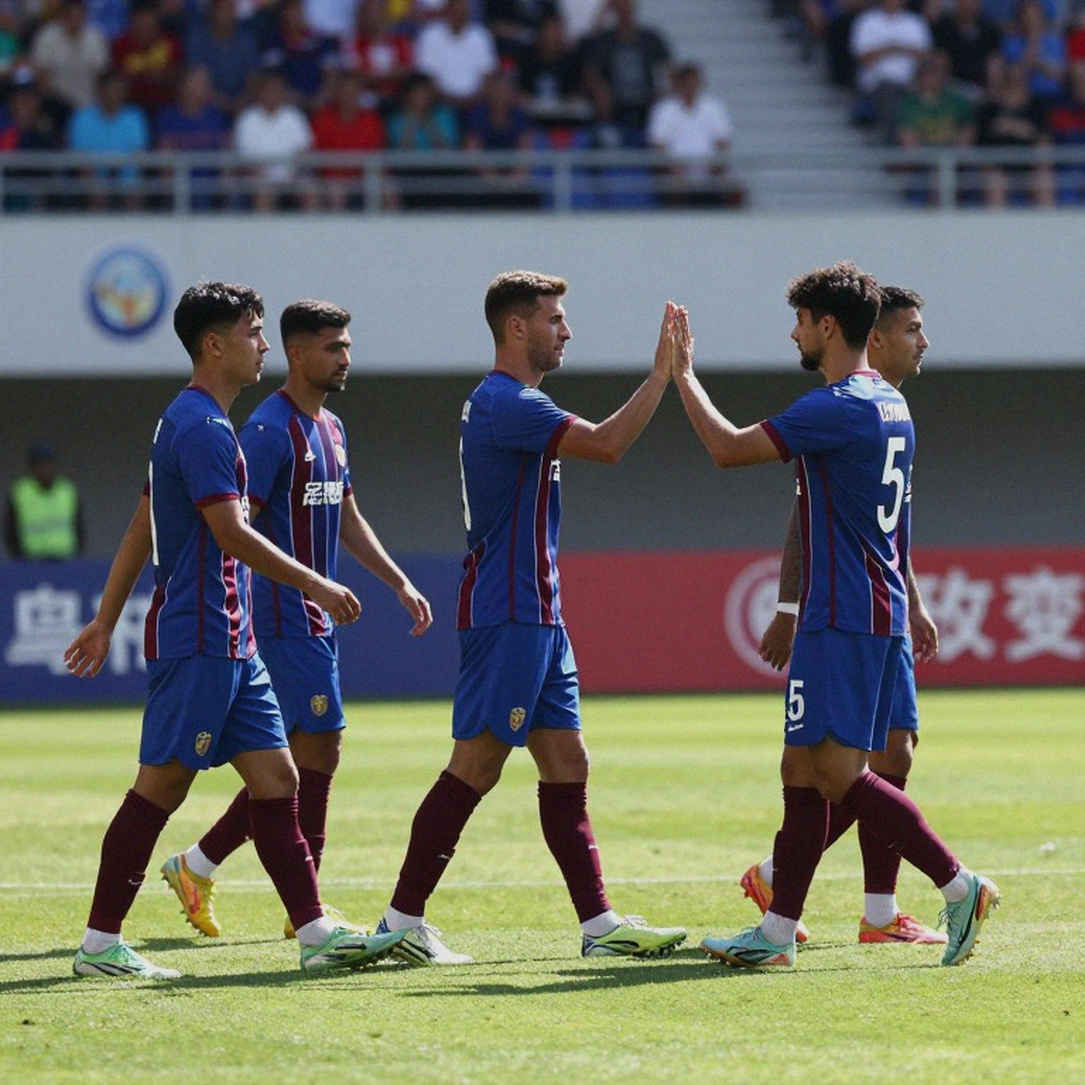
When the opponent is on the ball, do not watch the ball — watch the space they leave behind. But to see the space, I need a map. In Vietnam's top division, that map is still blank, and that blankness is quietly shaping every argument about the domestic game.
Vietnamese players do not run less than anyone else. The problem is that nobody measures how they run.
Vietnam's national championship — V.League 1 — is organised by Vietnam Professional Football (VPF) and governed by the Vietnam Football Federation (VFF). At the data layer, the league stops at the fairly basic: fixtures, results, standings, a handful of match stats such as shots and possession. The process metrics — expected goals (xG), expected goals against (xGA), PPDA, entries into the penalty area — barely exist in public form.
The difference lies not in expertise but in commercial infrastructure. The Premier League has optical tracking cameras in every stadium, and that data is resold to broadcasters, bookmakers and clubs. V.League has no such revenue stream, so it has no such system, so it has no such data.
Raw data is already scarce. At the financial layer, the opacity is far greater. No UEFA-style financial fair play disclosure regime applies to Vietnamese clubs; most are privately owned, sponsorship revenue is rarely itemised, and wage bills are effectively internal information. An analyst in England can open the annual accounts of a third-tier club and know how much debt it carries. In Vietnam, I cannot know what the champions pay their key players.
This sounds abstract until it collides with a concrete argument. The transfer window is open, and a familiar topic resurfaces: does the five-substitution rule actually make the league better? I belong to the camp that believes it deepens squads while turning the final twenty minutes into a war of attrition. The trouble is that I cannot prove it in V.League, and nobody can rebut me either. To know whether a side collapses in the last twenty minutes through exhaustion, through structural loss, or through nerves, you need load data — high-intensity distance, sprint counts, recovery time between bursts. Without it, every conclusion is just a feeling expressed fluently.
At national-team level, results have run ahead of the analytical infrastructure. Vietnam reached the third round of World Cup qualifying for the first time in the 2026 cycle, and won the ASEAN Championship in 2026 and 2026. Those results came from organisation, discipline and a good generation of players. But they were recorded by eye, not by model. When a defeat arrives, there is no baseline to distinguish an accident from a break point.
Then comes the part I consider most important and least discussed: where the money goes when a Vietnamese player moves abroad.
FIFA operates two mechanisms — training compensation and the solidarity contribution. In principle, when a player transfers internationally, the clubs that trained him between the ages of 12 and 23 share a portion of the fee. Nguyen Quang Hai joined Pau FC in 2026. Doan Van Hau joined SC Heerenveen in 2026. Dang Van Lam joined Muangthong United in 2026. Nguyen Cong Phuong joined Mito HollyHock in 2026. Each time, in theory, a small stream of money flows back to academies at home.
I tried to verify that stream. I could not. No publication states which club received how much, when, or through which mechanism. That is the problem: Vietnam's youth development system survives on thin resources, while a legitimate income stream, with clear international legal grounding, is not documented well enough to track.
Liverpool did not collapse because of an injury storm. Their machine forgot the language it ran on. I think of that every time a V.League club changes coach mid-season. The identity vanishes within three matches, and nobody can prove it ever existed — because no metric recorded how that team operated before. A system that is not measured is not protected.
Here is the counterintuitive part: the priority is not xG.
Analysts often demand that Vietnamese football adopt advanced metrics. But advanced metrics are a product for viewers. What determines whether a club survives into the next season is its balance sheet, its wage obligations and its ability to recover training money. A pretty metric makes an argument more fun; a transparent financial report keeps a fifteen-year-old academy from closing.
The real danger lies elsewhere: the empty space gets filled with noise. During the transfer window, Vietnamese transfer rumours spread fast with almost no source tiering — few ask whether a claim comes from an agent, from a club, or from an anonymous account. In England, I know who to trust and how far. In Vietnam, I usually only know whether to believe it, and that is a very expensive way to read the world.
Morocco did not come to Qatar to tell a fairy tale; they came to prove that defending is also a language of poetry. But I have rewatched footage of their training sessions — that language was designed, measured, repeated over more than a decade. Vietnamese football has had beautiful moments of the same kind, with one difference: we do not keep the blueprints.
If the 2026-2027 season ends with at least one V.League club publishing its full wage bill and its receipts from FIFA's training mechanism, that will be a bigger step forward than any xG model. It is a verifiable milestone, and I will be the first to record it.
If not, we will go back to rewinding footage, starting stopwatches and arguing from belief. How long can a league survive when nobody — including the league itself — knows what kind of football it is playing?